


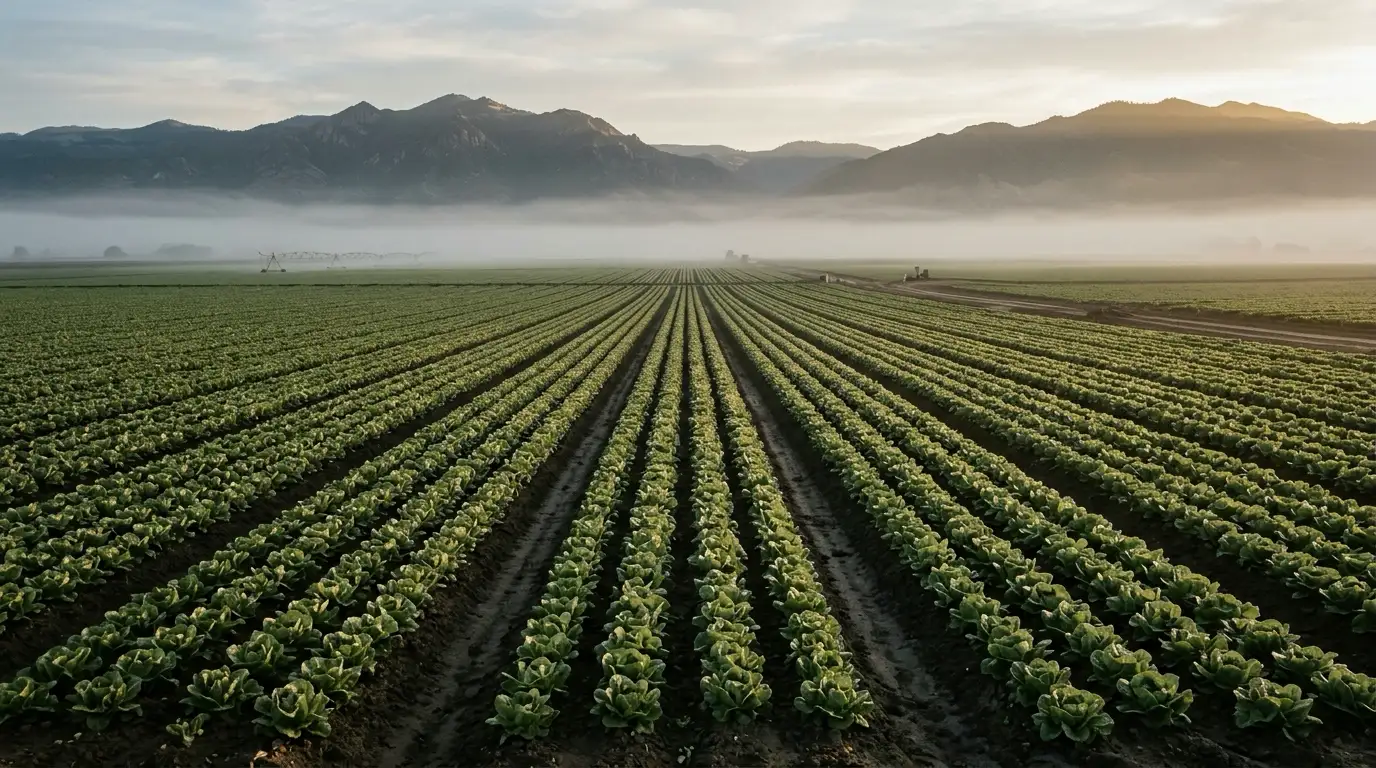
Agriculture
Agriculture Marketing Agency That Gets Buyers Calling Before Harvest
Machina is a growth marketing agency in Hollister, 25 minutes from the Salinas Valley, that markets farms, grower-shippers, and agtech companies: commodity-and-region SEO, harvest-timed campaigns, and fresh-sheet email, measured in buyers on the phone. We grew 101 Exterminators, a Salinas company, from $120K to $6.8M in two years.
Proof
Results, measured at packout
Revenue and response times, in the clients' own numbers.
What makes Agriculture different
The conditions this industry runs under
California agriculture runs on regulated, thinning margins. The H-2A Adverse Effect Wage Rate hit $19.97 an hour in 2025, second-highest in the nation, while SGMA groundwater limits tighten pumping in the Salinas Valley basin. FSMA 204 traceability arrives July 2028, and Walmart has required GS1-128 case labels since August 2025. Marketing competes with all of that, so ours reports a number every month. One scope note: wineries and tasting rooms run different economics, and we cover them separately under Agriculture & Wine.
What we hear
What growers and shippers tell us on the first call
Four complaints we hear across the Salinas Valley and San Benito County, and what we do about each.
“Every deal we close collapses to FOB price”
On a broker's sheet, your romaine looks identical to the next cooler's, so the sale becomes a price negotiation. We build buyer-facing sites that serve your certs as instant downloads, publish a live availability list, and name commodities by season, so diligence ends in a call instead of a counteroffer.
Web Development“We've shipped for 30 years and Google has never heard of us”
Organic search drives 42–48% of agriculture website traffic, and most of your competitors defend it with a site last rebuilt a decade ago. Commodity-and-region pages like "organic spinach grower Salinas Valley" face thin competition, so page-one positions are winnable in months, not years.
SEO“The farmers market stopped growing years ago”
USDA data shows direct-to-consumer sales flat since 2017, with 10.3% fewer farms selling direct. The farms still growing added e-commerce, subscription CSA billing, and retention email at agriculture's 24.5–28% open rates.
Email Marketing“Leads come in by phone and trade-show handshake, so we can't tell what works”
We wire call tracking to every channel and put quote requests into a CRM that holds a deal across a full season. Ag decisions cluster in the November–February off-season, so attribution must survive the gap between an August page view and a January signature.
AI AutomationWhat we do
Five services, built around your season
CPCs, open rates, contracting windows, cert diligence. Every service below is built around the numbers an ag business runs on.
Web Development
A grower-shipper site is due-diligence infrastructure. Buyers check three things before calling: certifications (PrimusGFS, GlobalG.A.P.) as instant downloads, a current availability list, and your cooler and shipping-point logistics. We build those in, mobile-fast for the trade-show floor and desktop-sharp for the close, because ag conversion runs 3.5% on desktop against 1.2% on mobile. DTC farms get CSA subscription billing and agritourism booking; agtech gets field-trial data and ROI calculators.
SEO
Nearly half of agriculture website traffic arrives through organic search, and your competitors mostly defend it with brochure sites. We build commodity-and-region pages ("romaine hearts supplier Salinas Valley", "GlobalG.A.P. certified strawberry grower Watsonville") that intercept wholesale buyers mid-diligence, plus answer-engine content for the compliance questions growers search: FSMA 204 deadlines, LGMA requirements, SGMA reporting. Page-one positions here take months, not years.
Paid Ads
Agriculture clicks cost $2.44–$2.85 against a $5.26 cross-industry average (WordStream, 2025), with acquisition near $85, because few ag businesses run paid search at all. Timing is the whole game: we flight campaigns to your harvest calendar and the pre-season contracting window, land them on desktop-optimized pages, and geo-fence Meta campaigns to the 30-mile radius that fills u-pick weekends and CSA signups. Retargeting keeps a 12–18 month agtech cycle warm.
Email Marketing
Agriculture posts 24.5–28% open rates and click-through up to 3.5%, among the best of any industry, because ag email is operationally useful. We build weekly fresh sheets that wholesale buyers forward internally, CSA retention flows that catch churn before renewal, pre-season campaigns that re-engage last year's contract buyers, and nurture sequences that pace an agtech deal across 18 months.
AI Automation
Lead capture built for how ag buys: quote requests routed to the right salesperson by commodity, missed-call text-back for owners in the field, and CRM pipelines that hold a deal across a full season. For shippers facing FSMA 204's July 2028 deadline, we automate the marketing side of compliance: published cert updates, buyer-facing traceability pages, and audit-document delivery without staff time. The same system answers for 101 Exterminators in under 30 seconds.
Who we work with
Who we work with
Segment by segment, the buyer changes, and so does the plan.
Grower-shippers
Buyers check certs, packout consistency, and program history before the first call. We make your food-safety story findable and your fresh sheet the one that gets forwarded, in a valley where the neighbors are Taylor Farms and D'Arrigo.
Berry & strawberry growers
Monterey County strawberries topped $1B in 2024, a county first, and berries carry 60% of Santa Cruz County's $741M crop value. Independents differentiate on certs, varieties, and season windows.
CSA farms & farm boxes
Direct-to-consumer is flat nationally and fewer farms sell direct each census. The ones growing sell subscriptions online and defend renewals with harvest-email retention.
U-pick & agritourism
The demand arrives through Maps. Photos, accurate seasonal hours, and review velocity decide whether the minivans find your ranch road or the next one.
Agtech startups
Fifty-plus companies at the Western Growers Center for Innovation compete for the same growers' attention. Pilots run 12–18 months, so marketing means field-trial proof, named grower references, and presence between demo and deal.
Ag suppliers & services
50% of farms bought inputs online in 2025, up 18% in two years. Packaging, equipment, and input sellers win with search presence and quote-response speed.
AI visibility
AI Search Visibility for Agriculture
Produce buyers and growers have started asking AI assistants the questions they used to type into Google: who ships organic spinach out of the Salinas Valley, which CSA delivers near Hollister. Answer engines assemble their recommendations from crawlable HTML: complete business profiles, entity data, certifications published as text, and pages that answer one question each. AI crawlers don't execute JavaScript, so proof buried in scripts never gets cited. We structure your commodity pages, cert data, and reviews so the machines can read and quote you. When someone asks ChatGPT for the best organic produce supplier in Salinas, we make sure it's you. Our free SEO report scores your AI visibility today, before we touch anything.
Monterey County crop production in 2024. Strawberries topped $1B for the first time.
agriculture search CPC, against $5.26 across industries
of ag website traffic arrives through organic search
Produce buyers vet you on Google before they call the cooler. Most grower-shippers are still showing them a 2012 brochure site.
Case study
From $120K to $6.8M in the middle of the Salad Bowl
101 Exterminators is a Salinas pest-control company: trucks, routes, licenses, seasonal demand, in the middle of the produce world. When Machina started, the company did $120K a year. Two years later it did $6.8M, averaging $567K a month. The build is the local demand machine growers, shippers, and agtech sellers need. Local SEO with 25+ city pages across Monterey, Santa Cruz, Santa Clara, and San Benito counties, and a Google Business Profile that holds the map pack. An AI agent that answers new leads in under 30 seconds, qualifies 73% of them, and books at 4.2x the rate of manual follow-up. Lifecycle automation gets 42% email opens, 78% SMS reads, and 62% of customers re-booking. Swap pest routes for farm-stand traffic or agtech demo requests and the machinery is identical.
Read the case study“Machina didn't just build us a website — they built us a business. The combination of the AI systems, the community work, and the digital marketing turned us from a guy with a truck into the company everyone calls first. We went from surviving to thriving.”
The Harvest Calendar System
How we work
The Harvest Calendar System: marketing planned like a crop plan, measured at signing.
See what buyers see
A free audit that searches your commodities the way a retail buyer would: where you rank, whether your certs are findable, how fast the site loads from a trade-show floor, and what the availability list says. What buyers find decides whether the call comes.
Plant before the season
Commodity-and-region pages, a rebuilt buyer-facing site, and campaigns flighted to your harvest windows and the winter contracting period. Fresh-sheet email starts building the list that carries the off-season.
Measure at packout
Call tracking on every channel and a CRM that holds a deal across a full season, so a page view in August gets credit for the program signed in January. You see cost per signed buyer and cut budgets on evidence.
Playbook
The Agriculture Marketing Playbook
California farms crossed $60 billion in cash receipts for the first time in 2024 ($61.2B, CDFA), and Monterey County alone produced $4.99 billion of it. The demand is real; the marketing serving it runs a generation behind, on static sites with no availability lists and no attribution. Eight tactics we run for Central Coast farms, shippers, and agtech companies, each with the math attached.
Publish your food-safety story before the buyer asks
Flight campaigns to the harvest calendar, not the fiscal one
Send a fresh sheet buyers forward
For agtech: sell the pilot, then staff the 18 months after it
Win the map for the farm stand, the u-pick, and the tour
Defend the CSA renewal before you chase the signup
Track the deal across the season, or you will cut the wrong budget
Sources
- Monterey County agriculture rebounded to $4.99 billion in gross production value in 2024 (+14.7% YoY), with strawberries the first single crop in county history to top $1 billion (Local News Matters, July 2025).
- California farms and ranches generated $61.2 billion in cash receipts in 2024, the first time state ag production crossed $60 billion, with $23.8 billion in exports (CDFA, September 2025).
- US producers sold $17.5 billion in food through direct marketing channels, a 25% inflation-adjusted increase since 2017, while the number of farms selling direct-to-consumer fell 10.3% to 116,617 (USDA ERS, 2022 Census, released February 2024).
- 85% of US farms have internet access, and 50% of farms used the internet to purchase agricultural inputs in 2025, an 18% jump from 2023 (USDA NASS Farm Computer Usage and Ownership, August 2025).
- The global agtech market was valued at $24.42 billion in 2024 and is projected to reach $48.98 billion by 2030, a 12.3% CAGR, with precision agriculture holding roughly 40% of the market (Precision Farming Dealer).
- US farm labor costs were forecast to exceed $53 billion in 2025, and California's H-2A Adverse Effect Wage Rate hit $19.97 per hour, second-highest in the nation (American Farm Bureau, 2025).
Related industries
Explore adjacent verticals
Agriculture marketing by city
Agriculture
Let's have buyers calling before the November contracting window
Start with a free audit. We'll search your commodities the way a produce buyer does, check your rankings, certs, and email program, and show you where the calls go instead. Twenty minutes, no obligation.
Last updated July 4, 2026