

Brand identity · Packaging · Paid social
Gloria
An Italian wine-based hard seltzer, built for mindful enjoyment. We designed the identity and the pack, and ran the paid social programme that made the direct-to-consumer channel carry the business.
- Client
- Gloria
- Category
- Wine-based hard seltzer
- Disciplines
- Identity, packaging, paid media
- Market
- DTC — United States
Wholesale had thinned. Direct had to carry it.
The brand arrived with the harder half of the problem already solved: good product, real inventory, and a shelf presence that worked when someone was standing in front of it. What it did not have was demand it owned. Retail and wholesale set the pace, and when that channel softened there was nothing underneath it.
The brief was narrow and it was the right one — make direct-to-consumer produce enough revenue to matter. Not a campaign. A channel.
We started where the leverage was. Paid social first, because it was the only lever that could move volume inside a quarter. The identity came after, once we knew what the market responded to and had spent enough to know it wasn't a guess.
The media programme
Two attribution models are given for every efficiency figure. The platform's own number is the one most case studies quote; the blended number is the one that survives contact with a finance team. Both are the programme's record.
What we actually ran
No secret. A conversion-optimised cold-audience programme, scaled slowly, on creative that earned the click.
- 01
Measurement before spend
The pixel went on the store before the engagement formally began, firing ViewContent, AddToCart and Purchase. By the time budget moved, the platform had months of behaviour to model against — which is the difference between a lookalike that works in week one and one that works in week six.
- 02
See, Think, Do — but start at Do
A single conversion campaign against cold audiences only, no retargeting. Retargeting flatters a report by harvesting demand that already exists; we needed proof the ads could create it. Optimising toward purchase let the platform filter the window shoppers out before they cost anything.
- 03
A one-day click window
The default seven-day window suits considered purchases. This was low-ticket and impulse-led, so a one-day click attribution told the truth about what the ad actually caused. Widening the window would have inflated every number on this page.
- 04
Lookalikes off real events
Interest-based audiences first, then lookalikes seeded on key page visitors, add-to-carts and purchasers once each pool was large enough to model. Audience recency matters more than size — a fourteen-day seed and a one-hundred-eighty-day seed describe different people.
- 05
Scaled 10–15%, gated on 5x
Budget rose in small steps every couple of days, and only while ROAS held above 5x. Large jumps force the platform to re-learn delivery, and the cost of that re-learning lands squarely on CPA.
- 06
One post ID, kept
New ad sets reused the existing post rather than spawning fresh creative, so likes, comments and shares accumulated on a single asset. Social proof compounds — for the algorithm and for the person deciding whether to trust the brand.
The creative is the variable that matters
Targeting and budget are table stakes — every competent operator has them. The asset is the only part of a placement that is exclusively yours, and it is the reason a thumb stops. Square, because most of the impression is mobile and 1:1 takes the most feed height per scroll.
Italian wine, lightly sparkling, nothing to apologise for the next morning. Made for long afternoons.

Real Italian wine, lightly sparkling. The Adriatic in a can — best served cold and unhurried.
Illustrations of the placement using Gloria's own creative, rebuilt in markup so the type stays sharp. Not screenshots of live ads.
Paid social paid for the other channels
The campaigns accounted for roughly a quarter of monthly revenue directly. The other three quarters arrived through organic, direct and referral — channels nobody touched during the period.
That is the argument for paid social that platform attribution can never make on its own. Demand created in a feed does not stay in the feed: it comes back as a branded search, a direct visit, a link from somewhere you did not pitch.
No SEO work was carried out during this window. The organic movement below is demand the paid programme created, arriving through a different door.
Organic search — change vs. prior period
- Brand + product query impressions+931%
- Clicks, non-brand product segment+1,134%
- Clicks, brand + product+831%
- Organic traffic+183%
- Non-brand impressions+198%
Queries split into brand and non-brand, each with a product-specific subcategory. The non-brand product segment carried the largest click-through gain of the set.
Referral — change vs. prior period
- Referral users, editorial coverage+1,206%
- Referral conversions+1,001%
- Organic social referral traffic+1,700%
Editorial pickups followed the paid exposure rather than a pitch. Conversion rate on that referral traffic rose 18% alongside the volume.
The rebrand
Then we gave the machine something better to spend against
A media system can only work with the assets it is handed. Once the channel was proven, the constraint moved upstream — to the brand itself. Gloria is the answer to that constraint.
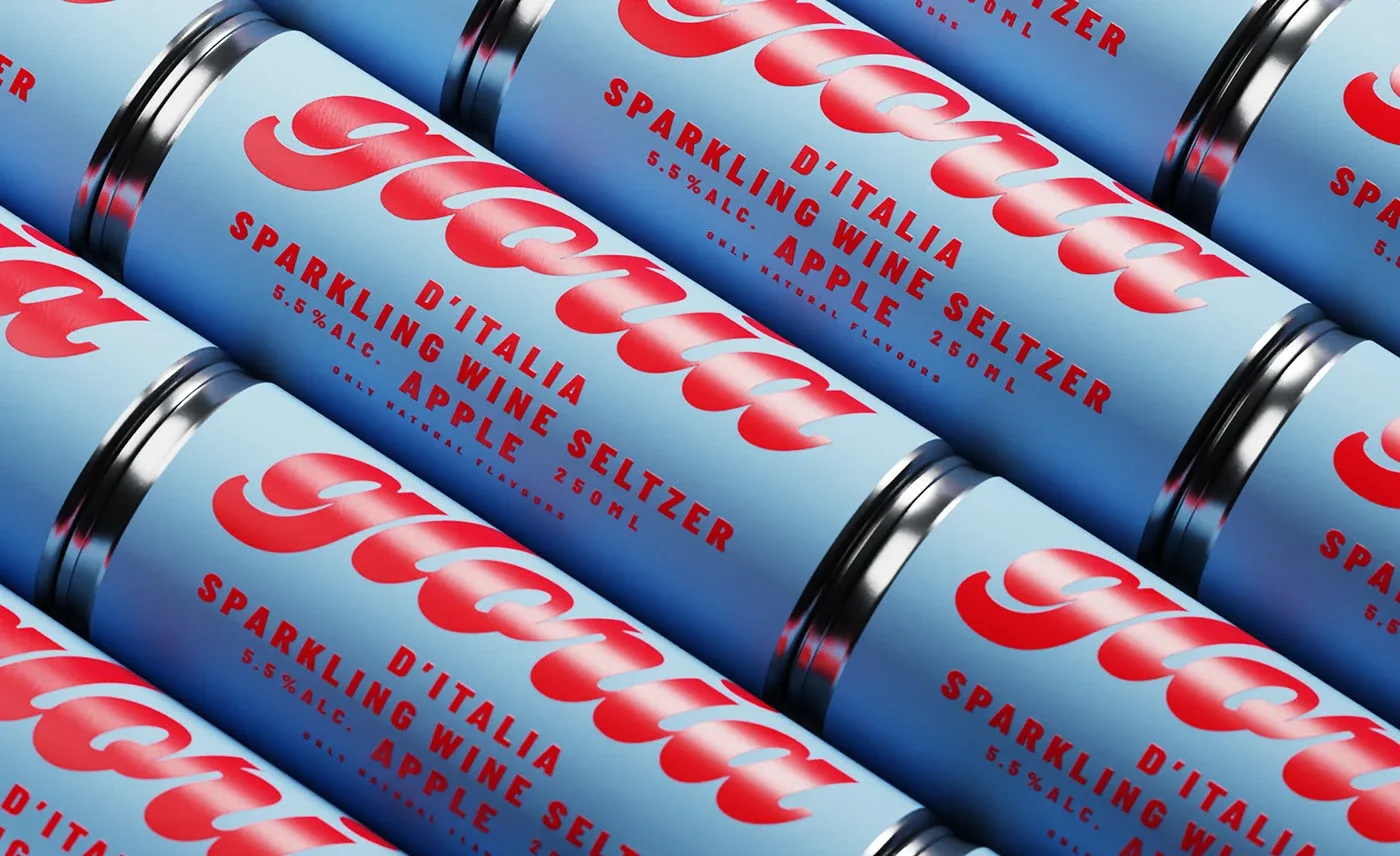
The identity draws on vintage Italian postcards and travel posters: the warmth of the Adriatic, leisure, effortless enjoyment, translated into a clear modern language. A script logotype with a coral-red heat to it, set against a sky blue that keeps the whole thing feeling like the middle of the afternoon.
The pack carries the same argument. Lightness and refreshment, a Mediterranean summer rather than a nutrition panel — an object that reads as a small pleasure instead of a permission slip.
What carried over
The media system did not change when the brand did. Same audience construction, same attribution discipline, same incremental scaling. That is the point of building a channel rather than running a campaign — it survives the thing it was built for being replaced.
What changed is what it had to spend against. A coherent identity does not make the arithmetic easier; it makes every impression worth more, because the asset in the placement is finally doing some of the work.