

10/10 Branding Moves for Boring Businesses
Home service branding gets judged at the curb and the front door, not in a logo file. These eight moves come from real companies: a name that is also a phone number, a fleet of pink trucks, a crew in kilts, a $5-a-minute promise. Each one comes with a plain way to copy it.

Francisco Contreras · Founder, Machina
10 min read
Key takeaways
- Home service branding gets tested at the front door: the truck, the uniform and the person on the step have to match the name the customer chose.
- You do not need a fleet. The Pest Company, founded in 2024 and run by one owner-technician, wraps a single pickup like a regional brand.
- Smith Total Home stacks moves: pink trucks for decades, plus a named USA Club plan listed from $60 to $588 a year in October 2026.
- The guarantees people remember carry a number. Benjamin Franklin Plumbing pays $5 for every minute it is late, up to $300.
- Start with one photo of your own truck beside your homepage and your last invoice, and fix the first thing that does not match.
Why home service branding starts at the front door
The doorbell rings and the homeowner opens it to a stranger. In a minute that stranger will be under the kitchen sink, or up in the attic, or walking the hall past the kids' rooms. The customer picked a name off a screen or the side of a truck. The person on the step now has to prove they belong to it.
That handoff is the real job of home service branding. The truck at the curb, the shirt, the badge and the card in the technician's hand either match the name the customer chose or they don't. When they match, the stranger reads as the company. When they don't, the customer spends the visit wondering who they let in.
Most trades still treat this as decoration: a white van, a stock logo, a polo from the supply catalog. The eight companies below made it the plan, and each move earns a ten. None of them are Machina clients. This is a reading of their public branding, checked against their own pages, and every move ends with a version you can copy at your size.
| Move | Real example | What to copy |
|---|---|---|
| 1. Name the result | 1-800-GOT-JUNK?: the name is the phone number and the problem | A name, or a line under it, that says what you fix |
| 2. Own one color | Smith Total Home: pink trucks for decades | One color on every truck, shirt and invoice |
| 3. Dress the crew | Men In Kilts: technicians in tartan kilts | One piece of uniform nobody else in town wears |
| 4. Make the truck the ad | The Pest Company: a frog-spotted lime-green pickup | One strong device, with the name and number large |
| 5. Shoot the doorstep | Benjamin Franklin Plumbing: a technician handing over a card | Photos of your real crew meeting real customers |
| 6. Give the promise a face | Mister Sparky: a mascot beside "America's On-Time Electrician" | A character that stands for one promise |
| 7. Name the plan | Smith Total Home: the USA Club, four tiers | A plan name customers can say on the phone |
| 8. Put a number on the guarantee | Benjamin Franklin Plumbing: $5 a minute late, $300 maximum | A guarantee with a trigger, a payout and a cap |
Company pages listed under Sources, read 14 October 2026. Prices and guarantee terms as published on that date; franchise locations are independently owned and local terms can vary.
1. Name the result customers want, not just the trade
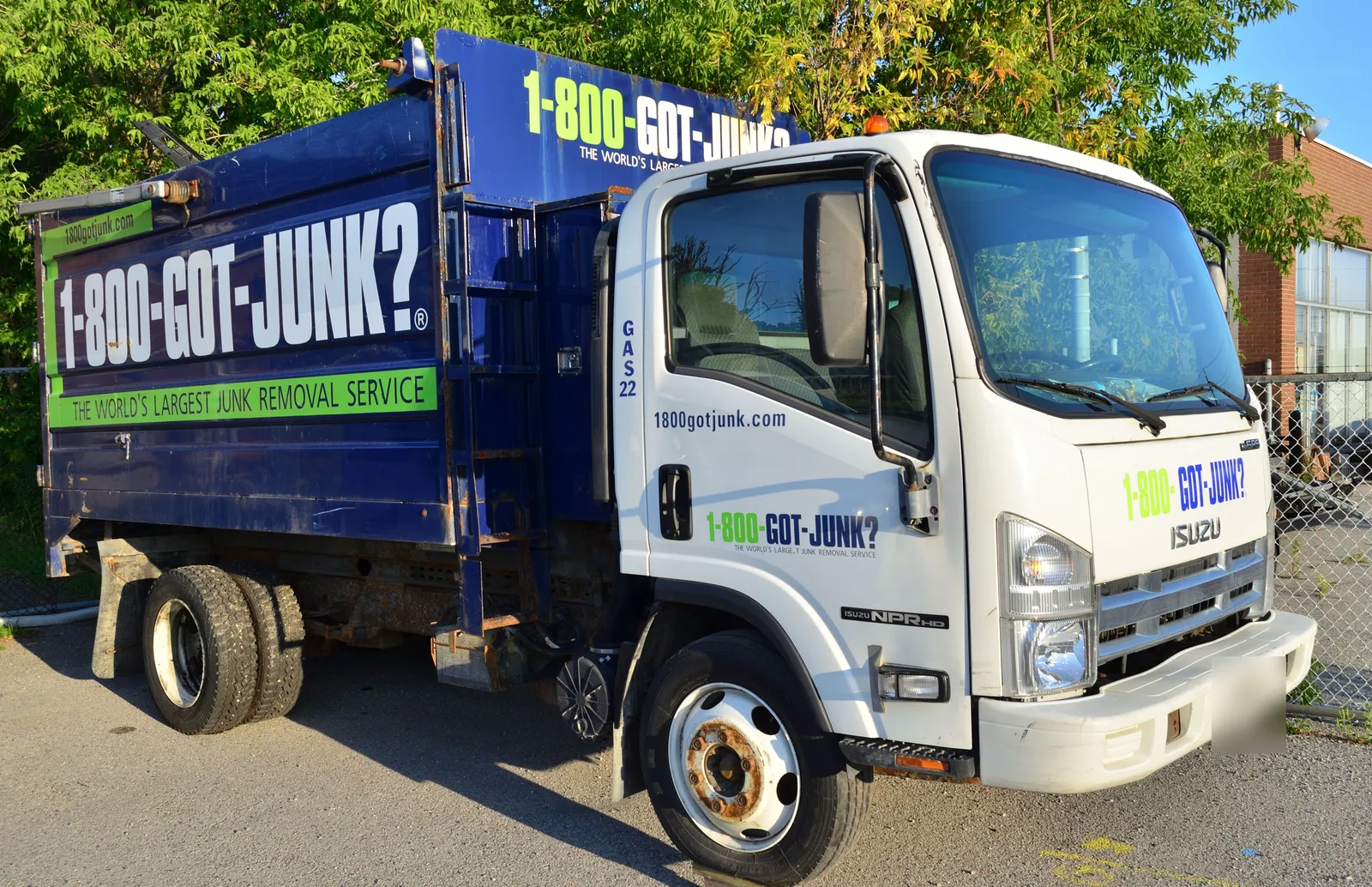
A lot of trade names are a surname plus a service. They tell you who and what, and they stop there. 1-800-GOT-JUNK? does more with the same few letters. Spelled out on a keypad, the name is the company's phone number, 1-800-468-5865. It is also the question a customer is already asking while staring at a garage full of old furniture.
The truck below does the rest. The name runs across the box in letters you could read from across a parking lot, with one line underneath naming the service. There is no list of services and no slogan fighting for room, because the name already carries both jobs: what the company does, and how to reach it.
How to copy it
You don't need to rename a company with twenty years of local goodwill. Keep the name and put the result in a short line under it, on the truck, the website header and the invoice. Write that line in the words customers use when they call: no heat, slow drain, roof leak. A new business has more room, and good home service business branding can start with the name itself.
2. Plumbing company branding in one color: Smith's pink trucks
Smith Total Home does plumbing, heating, air conditioning and electrical work across the Colorado Front Range, and its trucks are pink. Not a pink stripe on white, either. The whole truck is pink and dotted, with a navy panel for the Smith name and an illustrated woman in overalls on the door. The company says the color is a choice it made on purpose.
The pink trucks are our most recognizable brand asset and have been for decades. They are a deliberate choice — a daily public reminder that this is a woman-owned business that takes its work seriously.
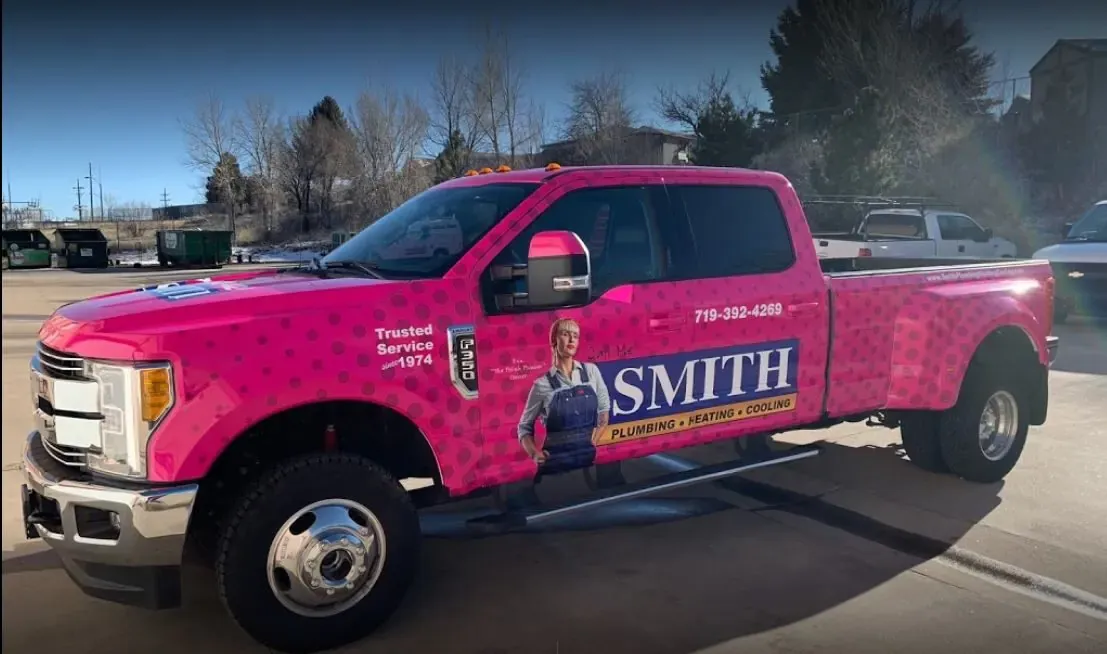
Color reads before any word on a truck does. The catch is time. A color only becomes yours after years on every surface a customer sees, and Smith counts its own run in decades. So the choice deserves real care, and the commitment afterward matters more than the shade.
- Survey the street first. Photograph the trucks of your five biggest local competitors, plumbing, HVAC or otherwise. Rule out every color you see twice.
- Test it outside. Print a large swatch and look at it in full sun and at dusk. Some shades wash out, and some turn muddy.
- Pick the lettering color at the same time. Your name has to read on that color from across the street, so the pair is one decision.
- Roll it out everywhere at once. Trucks, shirts, yard signs, website buttons, invoices and the text a customer gets when you confirm the visit.
3. Give the crew a uniform customers can spot from the street
Window and gutter cleaning is about as plain as a trade gets. Men In Kilts dresses its technicians in kilts. Its site calls them "our signature kilts" and turns the outfit into the promise: "When you spot the tartan, you know you're in good hands." In the photo the whole look works as one piece, with black shirts, black caps, green tartan and a van in the same green.
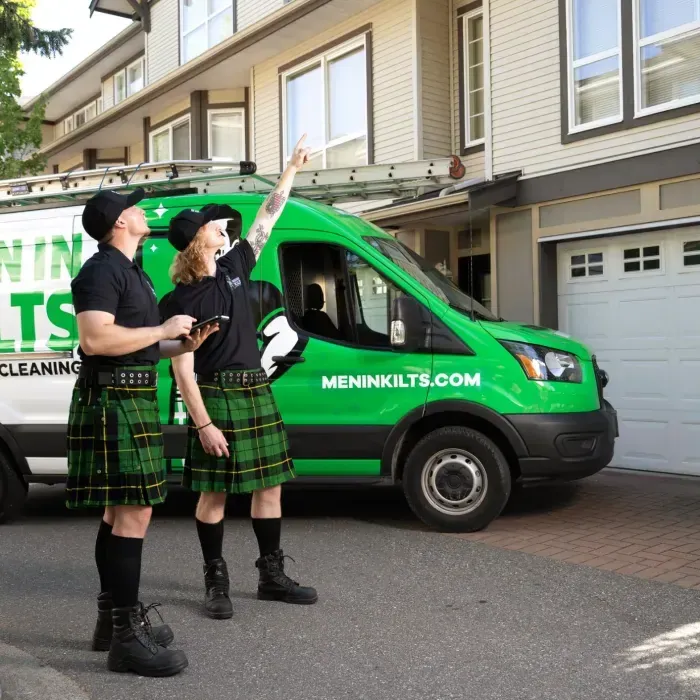
The kilt itself is a stunt that only a few brands could carry. The idea under it travels well: one piece of clothing doing the work of a logo, so the brand still shows when the technician is up a ladder and the van is out of sight. For most trades that piece is quieter. It might be a jacket in the brand color, a cap with a mark people learn, or a shirt that no supply catalog sells. Order it in every size from day one, so a new hire looks like the crew in their first week.
4. Service truck wrap ideas from a one-person company
You don't need a fleet to own a great truck. The Pest Company was founded in 2024, and its about page lists one person, the founder, as owner and technician, under the line "It's just me." The truck looks like a regional brand anyway. The whole pickup is lime green with dark frog spots, and a frog wearing a crown sits in a shield on the door.
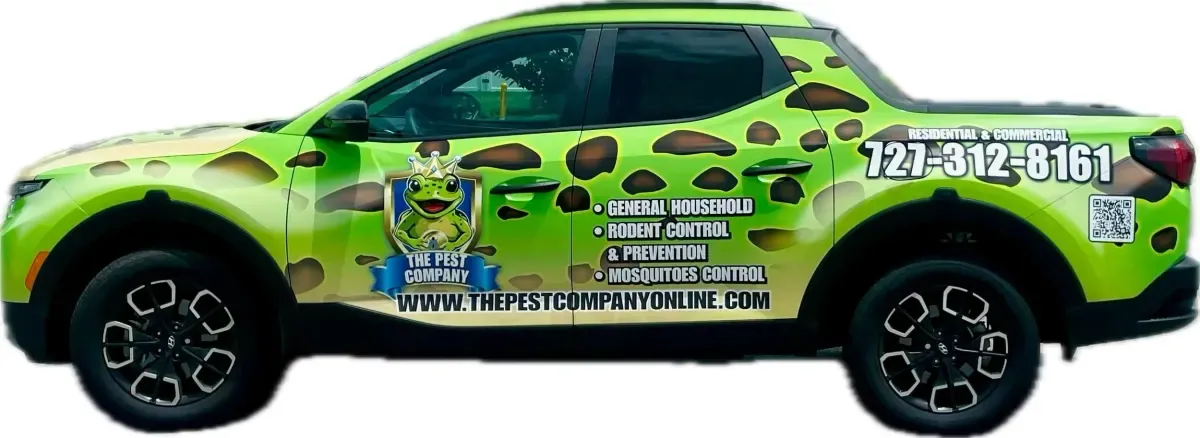
A wrapped truck is an ad that drives through your service area every working day. This one works because it picks one idea, the frog, and commits to it from bumper to bumper, while the facts that matter stay large: the name, the number and three services. Truck branding at this level costs one wrap, not a fleet. Before you pay for yours, put the design through five quick checks.
- 1
Shrink it
Look at the mockup on your phone at thumbnail size. That is close to what a driver sees from the next lane. - 2
Find the name and the number
If either one takes more than a glance to find, make it bigger and cut something else. - 3
Count the services
Three is plenty. A long list in small type reads as noise from a moving car. - 4
Pick one device
A color, a pattern or a character. When two of them compete, neither one sticks. - 5
Check the back doors
In traffic, the driver behind you sees nothing but the back of the truck. Put the name and the number there too.
5. Photograph the moment the customer meets you
The scene at the top of this article is a photo you can take. Benjamin Franklin Plumbing uses one on its franchise site. A technician stands at the front door in a white uniform shirt with a name badge and a logo patch. She holds a tablet in one hand and passes a branded card to the homeowners with the other. It shows the exact moment a customer worries about, going well.
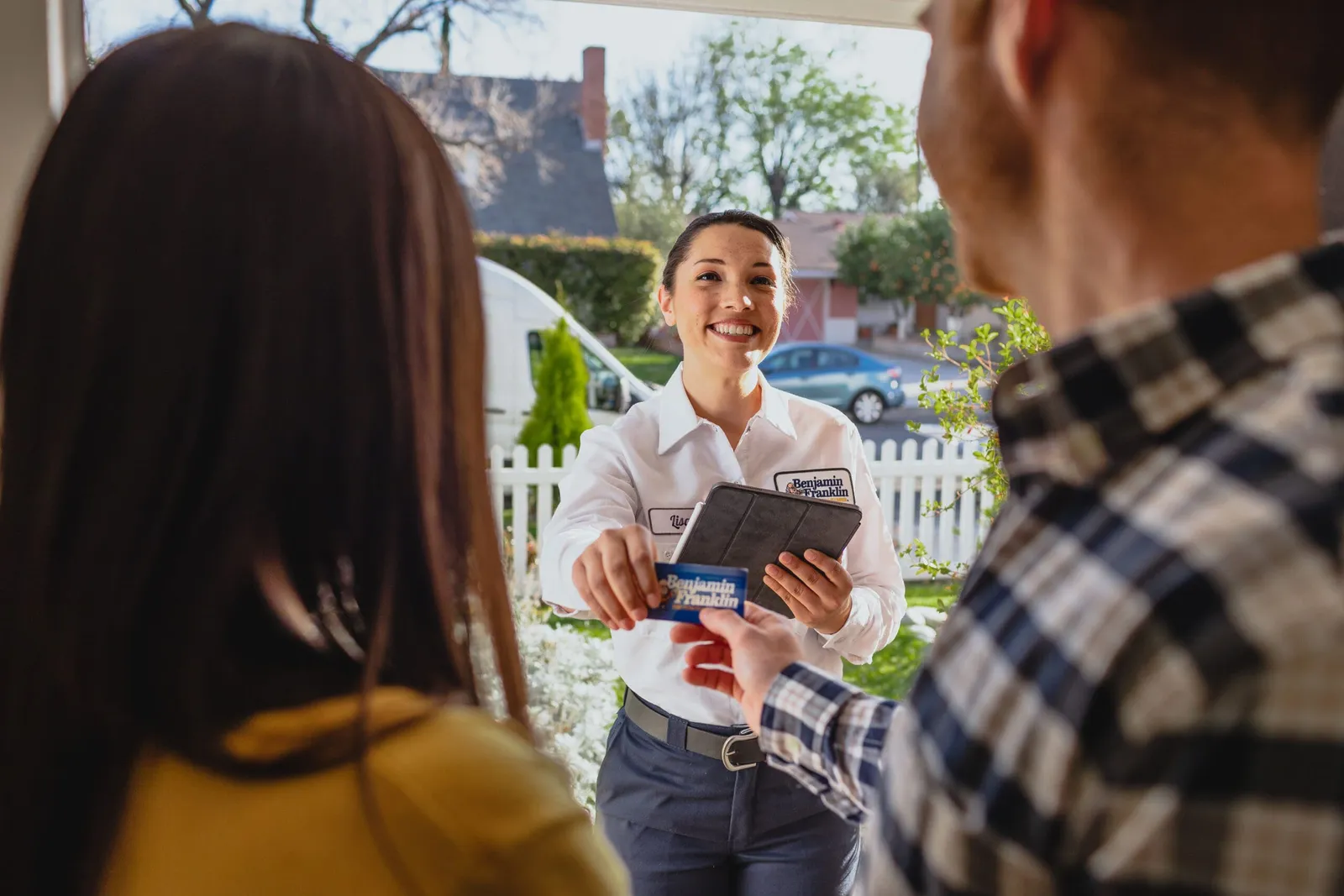
Plenty of home service websites run stock photos of a model in a hard hat. Those photos can't do this job, because the model will never ring anyone's bell. Your version uses your own people. Hire a photographer for half a day, or use a good phone in daylight, and shoot your real crew at a real door. Then use the same faces on the homepage, the service pages and your Google Business Profile, so the person who rings the bell is someone the customer has already seen.
- Get written permission from every person you photograph, and reshoot when the crew changes.
- Shoot the uniform clean and the truck washed. The photo sets the standard the visit has to meet.
- Capture the handoffs: the card at the door, the shoe covers, the explanation at the panel.
- Skip the arms-crossed team lineup. A customer meets one person at a time, so show one person at a time.
6. Give your promise a face with a mascot
Mister Sparky calls itself "America's On-Time Electrician." On the van in this photo, a cartoon character holding a yellow lightning bolt stands beside the Mister Sparky name, with that on-time line in red below. The character sits right next to the promise, so seeing one brings back the other.
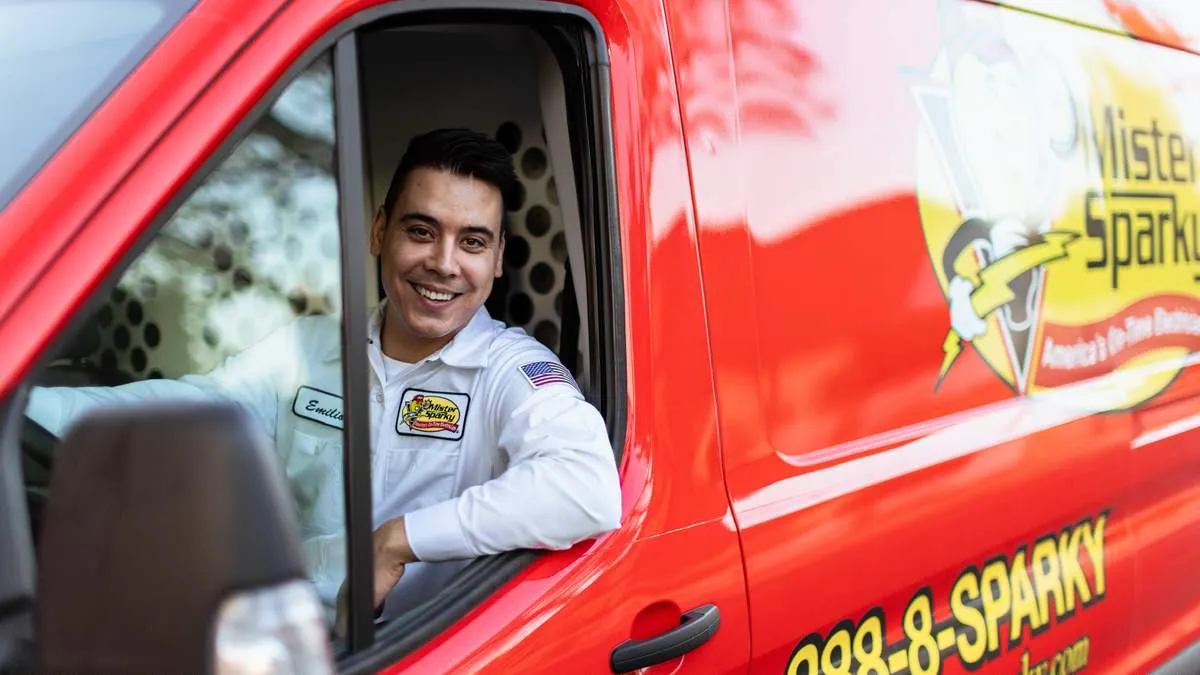
A mascot earns its place when it stands for one specific thing. A friendly cartoon that means nothing in particular is one more logo for customers to remember. Before anyone draws a character, write the one sentence it stands for, such as on time or spotless. If you can't write that sentence, spend the money on the name and the color instead.
7. Name your service plans so customers can ask for them
Smith Total Home shows up twice in this list, and that is a lesson on its own: the strongest brands stack their moves. The pink-truck company also gave its maintenance membership a name, the USA Club, and split it into four tiers. As listed in October 2026, Basic is $60 a year, Bronze $348, Silver $468 and Gold $588. Each tier carries one plain line, from annual inspections and tune-ups at Bronze to most repairs included at Gold.
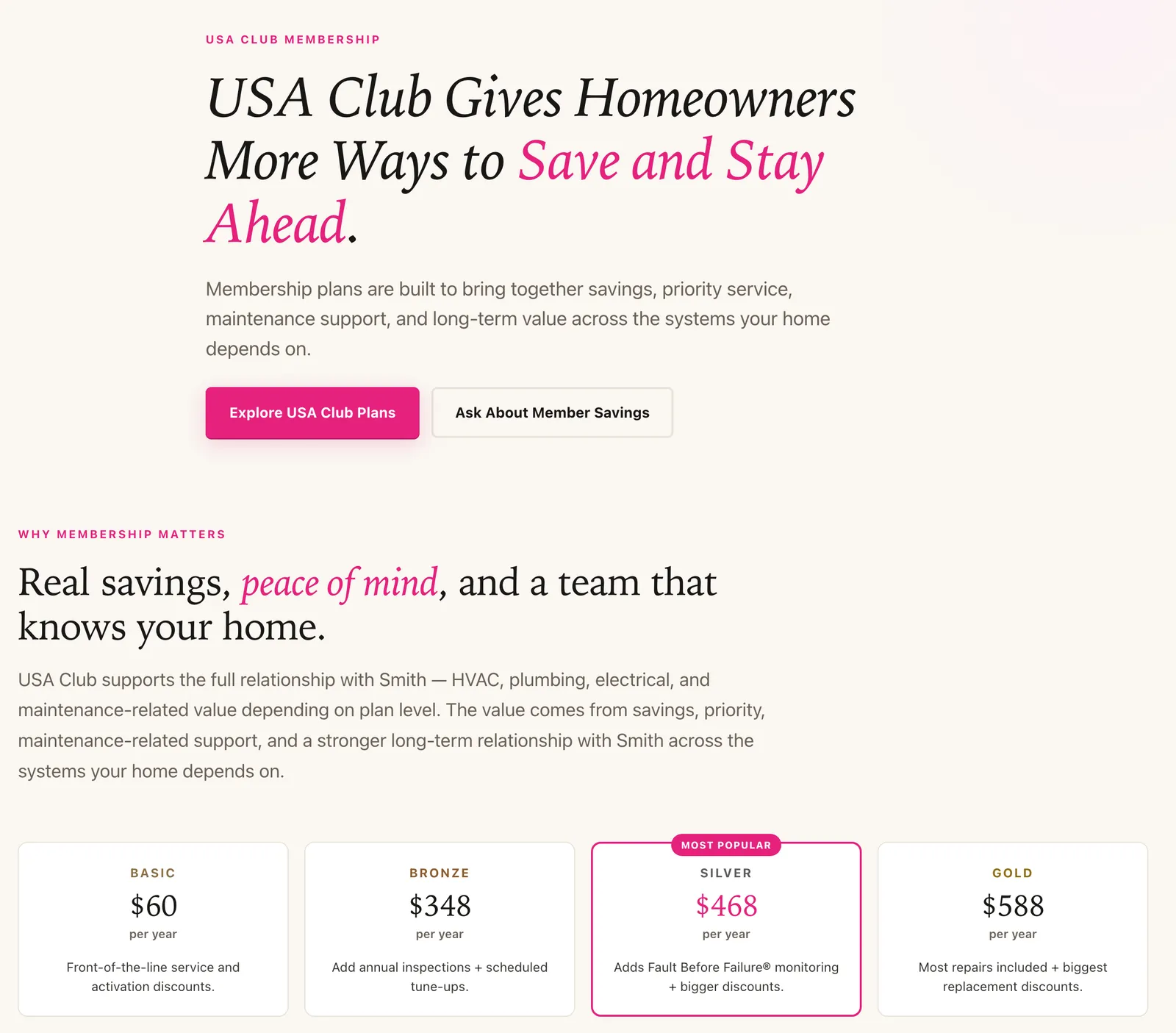
A name turns a maintenance visit into something a customer can ask for. "I'm in the USA Club" is easier to say than "I think I'm on some kind of plan with you." Electricians do it too. The Atlanta location of Mister Sparky calls its plan the Power Club, listed at $11.99 a month with one whole-home electrical and safety inspection a year.
- Name the plan once, and keep the tier names simple. The club name does the remembering, and the tiers only need to sort.
- Write each tier as one line about what the customer gets, in their words rather than your internal codes.
- Put the plan name everywhere the plan shows up: the truck, the invoice, the reminder text and the technician's pitch at the door.
- Show the prices on your site, and change them in one place when they move.
8. Put a number on your guarantee
Most guarantees say "satisfaction guaranteed" and leave the customer to work out what that means. Benjamin Franklin Plumbing wrote one a customer can check with a watch. The van calls the company The Punctual Plumber, and the guarantee page states the terms in plain words: "If There's Any Delay, It's You We Pay."
$5 a minute
Paid to the customer for every minute the plumber is late to a scheduled appointment, up to a $300 maximum.
Benjamin Franklin Plumbing, Our Guarantees page, read 14 October 2026. Each location is independently owned and operated, so check the local terms.
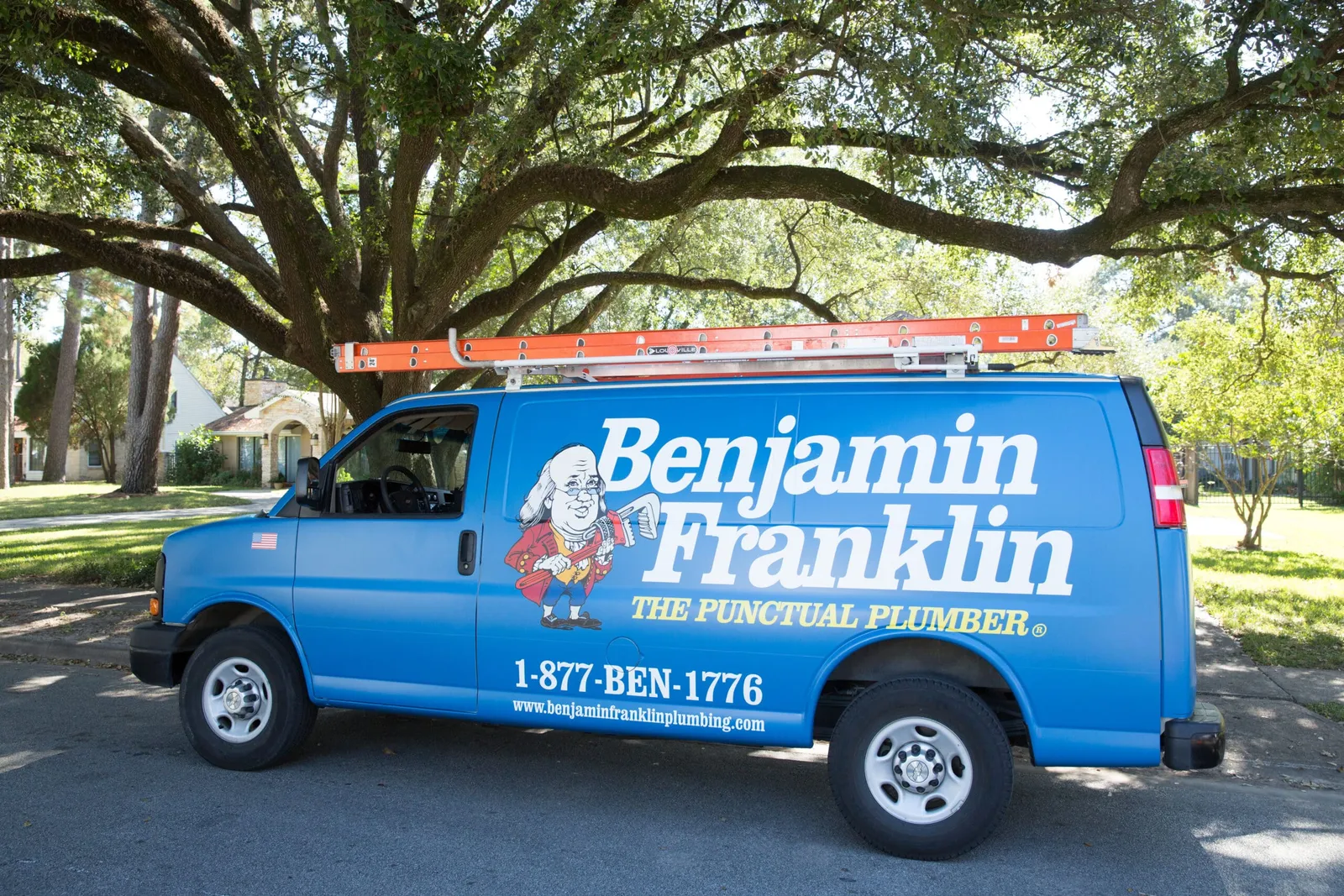
The company traces the idea to a problem in its trade. Its franchise site says that "plumbers didn't have the best reputation for arriving at appointments on time," so it made punctuality a cornerstone of the business. The name on the van, the slogan and the guarantee all point at that one promise, and the dollar figure is the part that makes it believable.
Write yours around something you control, such as the arrival window, the call-back time, a clean work area or a quote that doesn't move. Then give it four parts.
- The trigger. Exactly what counts as a miss.
- The payout. What the customer receives, in dollars or in work.
- The cap. The most you will pay on one job, so the promise stays affordable.
- The claim. How a customer asks for it, in one sentence.
Promise only what the office and the crew can keep on a bad day. A guarantee you break in public turns a brand promise into a complaint.
How to brand a home service business, starting with one photo
Branding for home service companies rarely starts with a new logo. It starts with what you already put on the street. Take one honest photo of your truck when it comes back from a job, dirt and all, and lay it next to your homepage and your last invoice.
The truck photo audit
Fix the first mismatch you find, then write the fix down as a rule, so the next truck and the next hire get it right without asking. That is how every company above earned its ten: one clear decision, used everywhere and kept. The next time a customer opens the door to your technician, the person on the step should already look familiar.
When you want those decisions made as one system, that is our branding and design work: brand strategy, visual identity and a website that matches the truck. Start a brand project and tell us what your truck looks like today.
FAQ
Frequently asked questions
What is home service branding?
It is everything a customer uses to recognize your company and decide to trust it: the name, the color, the trucks, the uniforms, the photos on your website, your service plans and your guarantee. In the trades it gets tested at the front door, when a stranger arrives and has to look like the company the customer called.
How do you brand a home service business on a small budget?
Start with what is already on the street. Pick one color and use it on every truck, shirt and invoice. Make the name and phone number large on the truck, photograph your real crew, and write one specific guarantee. The Pest Company, a one-person business founded in 2024, shows that a single well-wrapped truck can look like a regional brand.
What makes a good service truck wrap?
A name and phone number you can read at a glance, one memorable device such as a color, a pattern or a character, and no more than a few services. Test the design at thumbnail size on your phone, which is close to what a driver sees from the next lane, and repeat the name and number on the back doors.
Should a home service company have a mascot?
Only if it stands for one specific promise. Mister Sparky's character appears beside its "America's On-Time Electrician" line, so the mascot carries the on-time promise. A character with no promise behind it is one more logo for customers to remember.
What should a home service guarantee include?
Four parts: what counts as a miss, what the customer receives, the most you will pay, and how to claim it. Benjamin Franklin Plumbing's on-time guarantee pays $5 for every minute it is late to a scheduled appointment, up to $300. Its locations are independently owned and operated, so local terms can differ.
Do names for service plans matter?
A name gives customers something to ask for. Smith Total Home calls its membership the USA Club, with Basic, Bronze, Silver and Gold tiers listed at $60 to $588 a year in October 2026. Mister Sparky's Atlanta location calls its electrical plan the Power Club.
Sources
- Wikimedia Commons, "1800GOTJUNKTruck2.jpg" (CC0 1.0, photographed in Markham, Ontario, September 2019)
- 1-800-GOT-JUNK?, US homepage (customer service number 1-800-468-5865)
- Smith Total Home, "Our Company" (pink trucks; woman-owned Colorado business since 1974; plumbing, heating, air conditioning and electrical)
- Smith Total Home, "USA Club Membership" (four tiers and yearly prices, read 14 October 2026)
- Men In Kilts, "Why Us" (signature kilts; window and gutter cleaning)
- The Pest Company, "About" (founded 2024; owner and technician)
- Benjamin Franklin Plumbing, "Our Guarantees" ($5 per minute late, $300 maximum; locations independently owned and operated)
- Benjamin Franklin Plumbing Franchise, "About" (The Punctual Plumber; punctuality as a cornerstone)
- Mister Sparky, homepage ("America's On-Time Electrician")
- Mister Sparky of Atlanta, "Club Membership" (Power Club, $11.99 per month, read 14 October 2026)
- Country 99.1 WQIK, sponsored Mister Sparky feature (source of the van photograph, March 2025)
Keep reading
Related guides
Explore related work
Next steps
Let's talk about your project
Tell us what you're working on. We'll tell you if we can help — and exactly what we'd do.